Roadster Club
Flight demonstrations and the hardware
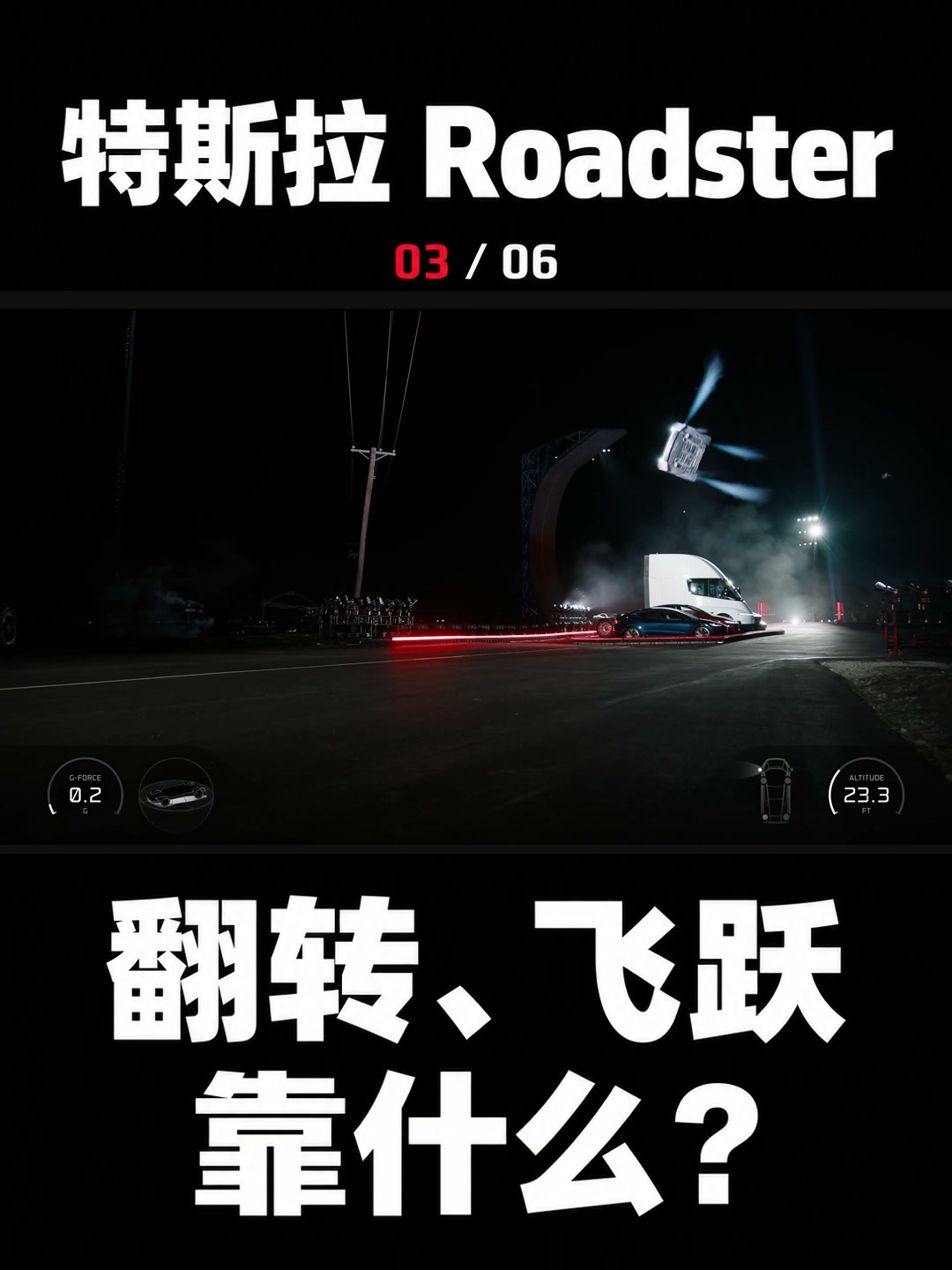
The first demonstration includes the vehicle climbing a large curved structure. A later sequence shows a longer airborne maneuver, a rotation and a jump over a line of Tesla vehicles. The presenters call the latter move a kickflip. Starman also appears, connecting the display with the earlier space story; the team explicitly says that the figure in the car is not a real human.
The explanation separates two systems. First is the fan suction system beneath the car. The presenters say it can generate up to about 2 g of suction-related force, holding the car against a surface and supporting the upside-down display. They emphasize the potential track benefit: additional downforce can improve grip for acceleration and cornering rather than relying on the car’s weight alone.
The second system uses a spaceflight-inspired approach to propulsion and attitude control. The car is described as having attitude-control nozzles around the body and main thrusters at the rear, enabling propulsion, rolls and other airborne motions. Suction and gas thrust serve different purposes: the former helps the car stay against a surface, while the latter adds force and controls its orientation.
For air storage, the presenters describe two pressure vessels with a combined volume of 600 liters, holding about 250 kilograms of air, and a total of ten nozzles. They say the tanks can be refilled on the car without adding a special propellant. Musk also raises the question of differing road laws across jurisdictions while emphasizing the vehicle’s extreme capabilities and entertainment value.
What to take from this chapter
Two systems work together: downforce increases surface grip, while compressed-air propulsion expands the vehicle’s possible maneuvers.
These are statements about the unveiling hardware, not independently measured production specifications. Tank pressure, flight endurance and final trim allocation are not established here.
- 2 tanks / 600 L
- Tank count and combined capacity stated in the recording.
- About 250 kg
- Claimed mass of stored air.
- 10 nozzles
- Total nozzle count stated in the recording.